https://edwardcurtin.com/the-life-and-public-assassination-of-president-john-f-kennedy-by-the-cia/
The Life and Public Assassination of President John F. Kennedy by the CIA
What is the truth, and where did it go?
Ask Oswald and Ruby, they oughta know
“Shut your mouth,” said the wise old owl
Business is business, and it’s a murder most foul
. . . . . . . . . . . . . . . . . . . . . . . . . . . . . . . . . . . . . .
Don’t worry, Mr. President
Help’s on the way
Your brothers are coming, there’ll be hell to pay
Brothers? What brothers? What’s this about hell?
Tell them, “We’re waiting, keep coming”
We’ll get them as well
– Bob Dylan, Murder Most Foul
Why President Kennedy was publicly murdered by the CIA sixty
years ago has never been more important. All pseudo-debates to the
contrary – including the numerous and growing claims that it was not the
U.S. national security state but the Israelis that assassinated the
president, which exonerates the CIA – the truth about the assassination
has long been evident. There is nothing to debate unless one is some
sort of intelligence operative, has an obsession, or is out to make a
name or a buck. I suggest that all those annual JFK conferences in
Dallas should finally end, but my guess is that they will be rolling
along for many more decades. To make an industry out of a tragedy is
wrong. And these conferences are so often devoted to examining and
debating minutiae that are a distraction from the essential truth.
As for the corporate mainstream media, they will never admit
the truth but will continue as long as necessary to titillate the public
with lies, limited hangouts, and sensational non-sequiturs. To do
otherwise would require admitting that they have long been complicit in
falsely reporting the crime and the endless coverup. That they are arms
of the CIA and NSA.
The Cold War, endless other wars, and the nuclear threat John
Kennedy worked so hard to end have today been inflamed to a fever pitch
by U.S. leaders in thrall to the forces that killed the president.
President Joseph Biden, like all the presidents that followed Kennedy,
is JFK’s opposite, an unrepentant war-monger, not only in Ukraine with
the U.S. war against Russia and the U.S. nuclear first-strike policy,
but throughout the world – the Middle-East, Africa, Syria, Iran, and on
and on, including the push for war with China.
Nowhere is this truer than with the U.S. support for the
current Israeli genocide of the Palestinians in Gaza, a slaughter also
supported by Robert Kennedy, Jr., who, ironically, is campaigning for
the presidency on the coattails of JFK and his father Senator Robert F.
Kennedy, who would be appalled by his unequivocal support for the
Israeli government. By such support and his silence as the slaughter in
Gaza continues, RFK, Jr. is, contrary his other expressed opinions,
supporting a wide range of war-related matters that involve the U.S.-
Israel alliance, which is central to the military-industrial forces
running U.S. foreign policy. To say this is dispiriting is a great
understatement, for RFK, Jr., a very intelligent man, knows that the CIA
killed his uncle and father, and he is campaigning as a spiritually
awakened man intent on ending the U.S. warfare state, something
impossible to accomplish when one gives full-fledged support to Israel.
And I believe he will be elected the next U.S. president.
The Biden administration is doing all in its power to undo
the legacy of JFK’s last year in office when on every front he fought
for peace, not war. It is not hard to realize that all presidents since
John Kennedy have been fully aware that a bullet to the head in broad
daylight could be their fate if they bucked their
bosses. They knew this when they sought the office because they were
run by the same bosses before election. Small-souled men, cowards on
the make, willing to sacrifice millions to their ambition.
I believe that the following article – my final one on this
matter – which I published two years ago, is worth reading again if you
have once done so, and even more important if you have never read it. It
is not based on speculation but on well-sourced facts, and it will make
clear the importance of President Kennedy and why his assassination lay
the foundation for today’s dire events. In this dark time, when the
world is spinning out of control, the story of his great courage in the
face of an assassination he expected, can inspire us to oppose the
systemic forces of evil that control the United States and are leading
the world into the abyss.
Despite a treasure-trove of new research and information having
emerged over the last sixty years, there are many people who still think
who killed President John Fitzgerald Kennedy and why are unanswerable
questions. They have drunk what Dr. Martin Schotz has called “the waters
of uncertainty” that results “in a state of confusion in which anything
can be believed but nothing can be known, nothing of significance that
is.”[1]
Then there are others who cling to the Lee Harvey Oswald “lone-nut” explanation proffered by the Warren Commission.
Both these groups tend to agree, however, that whatever the truth,
unknowable or allegedly known, it has no contemporary relevance but is
old-hat, ancient history, stuff for conspiracy-obsessed people with
nothing better to do. The general thinking is that the assassination
occurred more than a half-century ago, so let’s move on.
Nothing could be further from the truth, for the assassination of JFK
is the foundational event of modern American history, the Pandora’s box
from which many decades of tragedy have sprung.
Pressured to Wage War
From the day he was sworn in as President on January 20, 1961, John
F. Kennedy was relentlessly pressured by the Pentagon, the Central
Intelligence Agency, and by many of his own advisers to wage war –
clandestine, conventional, and nuclear.
To understand why and by whom he was assassinated on November 22,
1963, one needs to apprehend this pressure and the reasons why President
Kennedy consistently resisted it, as well as the consequences of that
resistance.
It is a key to understanding the current state of our world today and
why the United States has been waging endless foreign wars and creating
a national security surveillance state at home since JFK’s death.
A War Hero Who Was Appalled By War
It is very important to remember that Lieutenant John Kennedy was a
genuine Naval war hero in WW II, having risked his life and been badly
injured while saving his men in the treacherous waters of the South
Pacific after their PT boat was sunk by a Japanese destroyer. His older
brother Joe and his brother-in-law Billy Hartington had died in the war,
as had some of his boat’s crew members.
As a result, Kennedy was extremely sensitive to the horrors of war,
and, when he first ran for Congress in Massachusetts in 1946, he made it
explicitly clear that avoiding another war was his number one priority.
This commitment remained with him and was intensely strengthened
throughout his brief presidency until the day he died, fighting for
peace.
Despite much rhetoric to the contrary, this anti-war stance was
unusual for a politician, especially during the 1950s and 1960s. Kennedy
was a remarkable man, for even though he assumed the presidency as
somewhat of a cold warrior vis-à-vis the Soviet Union in particular, his
experiences in office rapidly chastened that stance. He very quickly
came to see that there were many people surrounding him who relished the
thought of war, even nuclear war, and he came to consider them as very
dangerous.
A Prescient Perspective
Yet even before he became president, in 1957, then Senator Kennedy
gave a speech in the U.S. Senate that sent shock waves throughout
Washington, D.C. and around the world.[2] He came out in support of Algerian independence from France and African liberation generally and against colonial imperialism.
As chair of the Senate’s African Subcommittee in 1959, he urged
sympathy for African independence movements as part of American foreign
policy. He believed that continued support of colonial policies would
only end in more bloodshed because the voices of independence would not
be denied, nor should they be.
That speech caused an international uproar, and in the U.S.A. Kennedy
was harshly criticized by Eisenhower, Nixon, John Foster Dulles, and
even members of the Democratic party, such as Adlai Stevenson and Dean
Acheson. But it was applauded in Africa and the Third World.
Yet JFK continued throughout his 1960 presidential campaign raising
his voice against colonialism throughout the world and for free and
independent African nations. Such views were anathema to the foreign
policy establishment, including the CIA and the burgeoning military
industrial complex that President Eisenhower belatedly warned against in
his Farewell Address, delivered nine months after approving the Bay of
Pigs invasion of Cuba in March 1960; this juxtaposition revealed the
hold the Pentagon and CIA had and has on sitting presidents, as the
pressure for war became structurally systemized.
Patrice Lumumba
One of Africa’s anti-colonial and nationalist leaders was the
charismatic Congolese Prime Minister Patrice Lumumba. In June, 1960, he
had become the first democratically elected leader of the Congo, a
country savagely raped and plundered for more than half a century by
Belgium’s King Leopold II for himself and multinational mining
companies. Kennedy’s support for African independence was well-known and
especially feared by the CIA, who, together with Brussels, considered
Lumumba, and Kennedy for supporting him, as threats to their interests
in the region.
So, three days before JFK’s inauguration, together with the Belgian
government, the CIA had Lumumba brutally assassinated after torturing
and beating him. According to Robert Johnson, a note taker at a National
Security Council meeting in August 1960, Lumumba’s assassination had
been approved by President Eisenhower when he gave Allen Dulles, the
Director of the CIA, the approval to “eliminate” Lumumba. Johnson
disclosed that in a 1975 interview that was discovered in 2000.[3]
On January 26, 1961, when Dulles briefed the new president on the
Congo, he did not tell JFK that they already had Lumumba assassinated
nine days before. This was meant to keep Kennedy on tenterhooks to teach
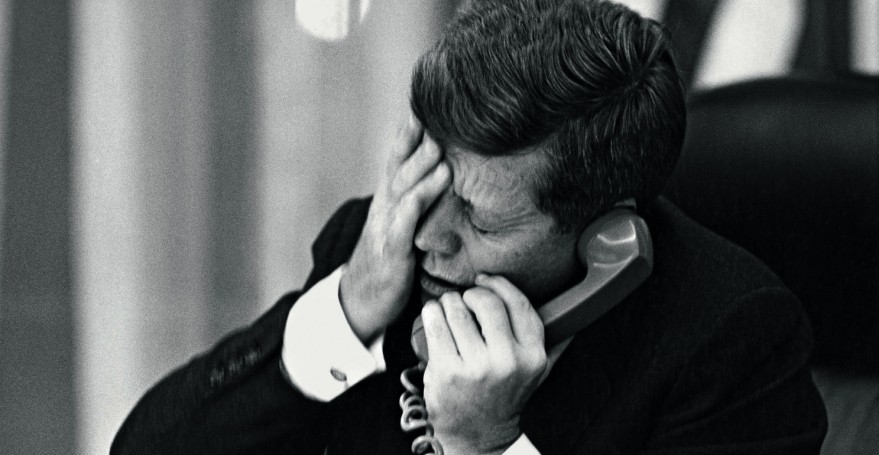
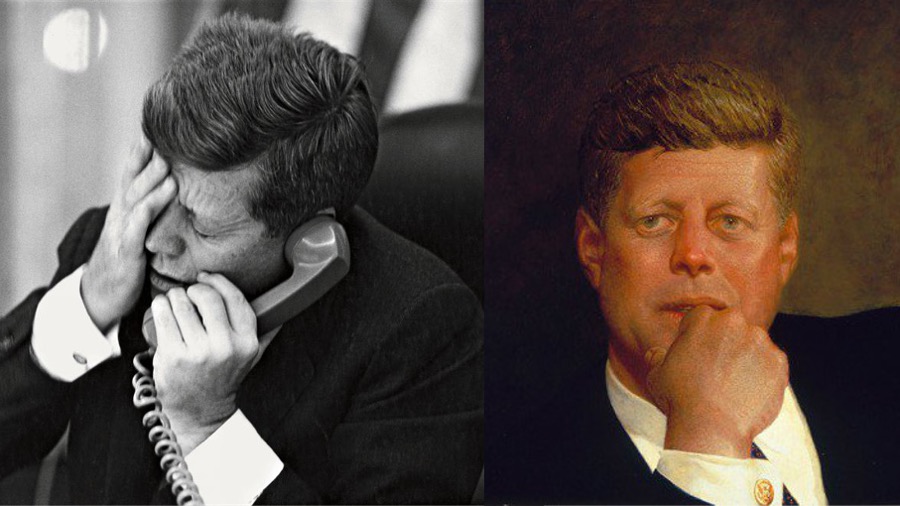
him a lesson. On February 13, 1961, Kennedy received a phone call from
his UN ambassador Adlai Stevenson informing him of Lumumba’s death.
There is a photograph by White House photographer Jacques Lowe of the horror-stricken president
sitting in the oval office answering that call that is harrowing to
view. It was an unmistakable portent of things to come, a warning for
the president.
Dag Hammarskjöld, Indonesia, and Sukarno
One of Kennedy’s crucial allies in his efforts to support third-world
independence was United Nations’ Secretary-General Dag Hammarskjöld.
Hammarskjöld had been deeply involved in peacekeeping in the Congo as
well as efforts to resolve disputes in Indonesia, both important
countries central to JFK’s concerns. Hammarskjöld was killed on
September 18, 1961 while on a peacekeeping mission to the Congo.
Substantial evidence exists that he was assassinated and that the CIA
and Allen Dulles were involved. Kennedy was devastated to lose such an
important ally.[4]
Kennedy’s strategy involved befriending Indonesia as a Cold War ally
as a crucial aspect of his Southeast Asian policy of dealing with Laos
and Vietnam and finding peaceful resolutions to other smoldering Cold
War conflicts. Hammarskjöld was also central to these efforts. The CIA,
led by Dulles, strongly opposed Kennedy’s strategy in Indonesia. In
fact, Dulles and the CIA had been involved in treacherous maneuverings
in resource rich Indonesia for decades. President Kennedy supported the Indonesian President Sukarno, while Dulles opposed him since he stood for Indonesian independence.
Just two days before Kennedy was killed on November 22, 1963, he had
accepted an invitation from Indonesian President Sukarno to visit that
country the following spring. The aim of the visit was to end the
conflict (Konfrontasi) between Indonesia and Malaysia and to
continue Kennedy’s efforts to support post-colonial Indonesia with
non-military economic and development aid. His goal was to end conflict
throughout Southeast Asia and assist the growth of democracy in newly
liberated post-colonial countries worldwide.
Of course, JFK never made it to Indonesia in 1964, and his peaceful
strategy to bring Indonesia to America’s side and to ease tensions in
the Cold War was never realized, thanks to Allen Dulles and the CIA.
And, Kennedy’s proposed withdrawal of American military advisers from
Vietnam, which, in part, was premised on success in Indonesia, was
quickly reversed by Lyndon Johnson after JFK’s murder and within a short
time hundreds of thousand American combat troops were sent to Vietnam.
In Indonesia, Sukarno would be forced out and replaced by General
Suharto, who would rule with an iron fist for the next 30 years. Soon,
both countries would experience mass slaughter engineered by Kennedy’s
opponents in the CIA and Pentagon.[5]
The Bay of Pigs
In mid-April 1961, less than three months into his presidency, a trap
was set for President Kennedy by the CIA and its director, Allen
Dulles, who knew of Kennedy’s reluctance to invade Cuba. They assumed
the new president would be forced by circumstances at the last minute to
send in U.S. Navy and Marine forces to back the invasion that they had
planned. The CIA and generals wanted to oust Fidel Castro, and in
pursuit of that goal, trained a force of Cuban exiles to invade Cuba.
This had started under President Eisenhower and Vice President Nixon.
Kennedy refused to go along with sending in American troops and the
invasion was roundly defeated. The CIA, military, and Cuban exiles
bitterly blamed Kennedy.
But it was all a sham. Classified documents uncovered in 2000
revealed that the CIA had discovered that the Soviets had learned the
date of the invasion more than a week in advance and had informed Cuban
Prime Minister Fidel Castro, but—and here is a startling fact that
should make people’s hair stand on end—the CIA never told the President.
The CIA knew the invasion was probably doomed before the fact but went
ahead with it anyway.
Why? So, they could blame JFK for the failure afterwards.
Kennedy later said to his friends Dave Powell and Ken O’Donnell,
“They were sure I’d give in to them and send the go-ahead order to the
[Navy’s aircraft carrier] Essex. They couldn’t believe that a new president like me wouldn’t panic and save his own face. Well, they had me figured all wrong.”[6]
This treachery set the stage for events to come. Sensing but not
knowing the full extent of the set-up, Kennedy fired CIA Director Allen
Dulles (who, as in a bad joke, was later named to the Warren Commission
investigating JFK’s assassination) and his assistant, General Charles
Cabell (whose brother, Earle Cabell, to make a bad joke absurd, was the
mayor of Dallas on the day Kennedy was killed.) It was later discovered
that Earle Cabell was a CIA asset.[7]
JFK said he wanted “to splinter the CIA in a thousand pieces and
scatter it to the winds.” Not sentiments to endear him to a secretive
government within a government whose power was growing exponentially.[8]
Kennedy Responds After the Bay of Pigs Treachery
The stage was now set for events to follow as JFK, now even more
suspicious of the military-intelligence people around him, and in
opposition to nearly all his advisers, consistently opposed the use of
force in U.S. foreign policy.
In 1961, despite the Joint Chiefs’ demand to put combat troops into
Laos – advising 140,000 by the end of April – Kennedy bluntly insisted
otherwise as he ordered Averell Harriman, his representative at the
Geneva Conference, “Did you understand? I want a negotiated settlement
in Laos. I don’t want to put troops in.”[9]
The president knew that Laos and Vietnam were linked issues, and since
Laos came first on his agenda, he was determined to push for a neutral
Laos.
Also in 1961, he refused to accede to the insistence of his top
generals to give them permission to use nuclear weapons in a dispute
with the Soviet Union over Berlin and Southeast Asia. Walking out of a
meeting with his top military advisors, Kennedy threw his hands in the
air and said, “These people are crazy.”[10]
In March 1962, the CIA, in the person of legendary operative, Edward
Lansdale, and with the approval of every member of the Joint Chiefs of
Staff, presented the president with a pretext for a U.S. invasion of
Cuba. Code-named Operation Northwoods, the
false-flag plan called for innocent people to be shot in the U.S.,
boats carrying Cuban refugees to be sunk and a terrorism campaign to be
launched in Miami, Washington D.C., and other places, all to be blamed
on the Castro government so that the public would be outraged and call
for an invasion of Cuba.[11]
Kennedy was appalled and rejected this pressure to manipulate him
into agreeing to terrorist attacks on Americans that could later be used
against him. He already knew that his life was in danger and that the
CIA and military were tightening a noose around his neck. But he refused
to yield.
As early as June 26, 1961, in a White House meeting with Soviet
Premier Nikita Khrushchev’s spokesperson, Mikhail Kharlamov, and
Khrushchev’s son-in-law, Alexei Adzhubei, when asked by Kharlamov why he
wasn’t moving faster to advance relations between the two countries,
JFK said “You don’t understand this country. If I move too fast on
U.S.-Soviet relations, I’ll either be thrown into an insane asylum, or
be killed.”[12]
JFK refused to bomb and invade Cuba as the military wished during the
Cuban missile crisis in October 1962. The Soviets had placed offensive
nuclear missiles and more than 30,000 support troops in Cuba to prevent
another U.S.-led invasion. American aerial photography had detected the
missiles. This was understandably unacceptable to the U.S. government.
While being urged by the Joint Chiefs and his trusted advisors to order a
preemptive nuclear strike on Cuba, JFK knew that a diplomatic solution
was the only way out as he wouldn’t accept the death of hundreds of
millions of people that would likely follow a series of nuclear
exchanges with the Soviet Union. Only his brother, Robert, and Secretary
of Defense Robert McNamara stood with him in opposing the use of
nuclear weapons. Daniel Ellsberg, a former Pentagon and Rand Corporation
analyst, reported a coup atmosphere in the Pentagon as Kennedy chose to
settle rather than attack.[13]
In the end, after thirteen incredibly tense days of brinksmanship,
Kennedy and Soviet Premier Nikita Khrushchev miraculously found a way to
resolve the crisis and prevent the use of those weapons.
Afterwards, JFK told his friend John Kenneth Galbraith that “I never had the slightest intention of doing so.”[14]
The Fateful Year 1963
In June, 1963, JFK gave an historic speech at American University in
which he called for the total abolishment of nuclear weapons, the end of
the Cold War and the “Pax Americana enforced on the world by American
weapons of war,” and movement toward “general and complete disarmament.”[15]
A few months later he signed a Limited Test Ban Treaty with Nikita Khrushchev.[16]
In October 1963 he signed National Security Action Memorandum 263
calling for the withdrawal of 1,000 U. S. military troops from Vietnam
by the end of the year and complete withdrawal by the end of 1965.[17]
All this he did while secretly engaging in negotiations with Soviet Premier Nikita Khrushchev via Saturday Evening Post editor and anti-nuclear weapon advocate, Norman Cousins, Soviet agent Georgi Bolshakov,[18] and Pope John XXIII,[19] as well as with Cuba’s Prime Minister Fidel Castro through various intermediaries, one of whom was French Journalist Jean Daniel. Of course, secret was not secret when the CIA was involved.
Kennedy, deeply disturbed by the near nuclear catastrophe of the
Cuban missile crisis, was determined to open back channel communications
to make sure such a near miss never happened again. He knew fault lay
on both sides, and that one slipup or miscommunication could initiate a
nuclear holocaust. He was determined, therefore, to try to open lines
of communications with his enemies.
Jean Daniel was going to Cuba to interview Fidel Castro, but before
he did he interviewed Kennedy on October 24, 1963. Kennedy, knowing
Daniel would tell Castro what he said, asked Daniel if Castro realizes
that “through his fault the world was on the verge of nuclear war in
October 1962….or even if he cares about it.” But he also added, to
soften the message:
“I approved the proclamation Fidel Castro made in the Sierra Maestra,
when he justifiably called for justice and especially yearned to rid
Cuba of corruption. I will go even further: to some extent it is as
though Batista was the incarnation of a number of sins on the part of
the United States. Now we will have to pay for those sins. In the matter
of the Batista regime, I am in agreement with the first Cuban
revolutionaries. That is perfectly clear.”[20]
Such sentiments were anathema, shall we say treasonous, to the CIA
and top Pentagon generals. These clear refusals to go to war with Cuba,
to emphasize peace and negotiated solutions to conflicts rather than
war, to order the withdrawal of all military personnel from Vietnam, to
call for an end to the Cold War, and his willingness to engage in
private, back-channel communications with Cold War enemies marked
Kennedy as an enemy of the national security state. They were on a
collision course.
The Assassination on November 22, 1963
After going through the Bay of Pigs, Cuban Missile Crisis and many
other military cliffhangers, Kennedy underwent a deep metanoia, a
spiritual transformation, from Cold Warrior to peacemaker. He came to
regard the generals who advised him as devaluing human life and
hell-bent on launching nuclear wars. And he was well aware that his
growing resistance to war had put him on a dangerous collision course
with those generals and the CIA. On numerous occasions, he spoke of the
possibility of a military coup d’état against him.
The night before his trip to Dallas, he told his wife, “But, Jackie,
if somebody wants to shoot me from a window with a rifle, nobody can
stop it, so why worry about it.”[21]
And we know that nobody did try to stop it because they had planned his execution from multiple locations to assure its success.
Who Killed Him?
If the only things you read, watched, or listened to since 1963 were
the mainstream corporate media (MSM), you would be convinced that the
official explanation for JFK’s assassination, the Warren Commission,
was correct in essentials. You would be wrong, because those corporate
media have for all these years served as mouthpieces for the government,
most notably the CIA that infiltrated and controlled them long ago
under a secret program called Operation Mockingbird.[22] In 1977, celebrated Watergate journalist, Carl Bernstein, published a 25,000-word cover story for Rolling Stone, “The CIA and the Media,” in which he published the names of many journalists and media, such as The New York Times, CBS, Time, Newsweek,
etc., who worked hand in glove with the CIA for decades. Ironically, or
as part of “a limited hangout” (spy talk for admitting some truths
while concealing deeper ones), this article can be found at the CIA’s
own website.
Total control of information requires media complicity, and with the
JFK assassination, and in all matters they consider important, the CIA
and the MSM are unified.[23]
Such control extends to literature, arts, and popular culture as well
as news. Frances Stonor Saunders comprehensively documents this in her
1999 book, The Cultural Cold War: The CIA And The World Of Arts And Letters,[24] and Joel Whitney followed this up in 2016 with Finks: How the CIA Tricked the World’s Best Writers, with particular emphasis on the complicity of the CIA and the famous literary journal The
Paris Review. Such revelations are retrospective, of course, but only
the most naïve would conclude such operations are a thing of the past.
The Warren Commission claimed that the president was shot by an ex-Marine named Lee Harvey Oswald, firing three bullets from the 6th
floor of the Texas School Book Depository as Kennedy’s car was already
two hundred and fifty feet past and driving away from him. But this is
patently false for many reasons, including the bizarre claim that one of
these bullets, later termed “the magic bullet,” passed through
Kennedy’s body and zigzagged up and down, left and right, striking Texas
Governor John Connolly who was sitting in the front seat and causing
seven wounds in all, only to be found later in pristine condition on a
stretcher in Parkland Hospital.[25] And, any lone assassin looking out the 6th floor window would have taken the perfect shot as the limousine approached within forty feet of the TSBD on Houston St.
The absurdity of the government’s claim, a ballistic fairy tale, was
the key to its assertion that Oswald killed Kennedy. It was visually
shattered and rendered ridiculous by the famous Zapruder film that
clearly shows the president being shot from the front right, and, as the
right front of his head explodes, he is violently thrown back and to
his left as Jacqueline Kennedy climbs on to the car’s trunk to retrieve a
piece of her husband’s skull and brain.
This video evidence is clear and simple proof of a conspiracy.[26]
Who Was Lee Harvey Oswald?
But there is another way to examine it.
If Lee Harvey Oswald, the man The Warren Commission said
killed JFK, was connected to the intelligence community, the FBI and the
CIA, then we can logically conclude that he was not “a lone-nut”
assassin or not an assassin at all. There is a wealth of evidence to
show how, from the very start, Oswald was moved around the globe by the
CIA like a pawn in a game, and when the game was done, the pawn was
eliminated in the Dallas police headquarters by Jack Ruby two days
later.
James W. Douglass, in JFK and the Unspeakable: Why He Died and Why It Matters, the most important book on the matter, asks this question:
Why was Lee Harvey Oswald so tolerated and supported by the government he betrayed?
This is a key question.
After serving as a U.S. Marine at the CIA’s U-2 spy plane Atsugi Air
Force Base in Japan with a Crypto clearance (higher than top secret, a
fact suppressed by the Warren Commission) and being trained in the
Russian language, Oswald left the Marines and defected to the Soviet
Union.[27]
After denouncing the U.S., rejecting his American citizenship, working
at a Soviet factory in Minsk, and taking a Russian wife—during which
time Gary Powers’ U-2 spy plane was shot down over the Soviet Union—he
returned to the U.S. with a loan from the American Embassy in Moscow,
only to be met at the dock in Hoboken, New Jersey, by Spas T. Raikin, a
prominent anti-Communist with extensive intelligence connections
recommended by the State Department.[28]
Oswald passed through immigration with no trouble, was not
prosecuted, moved to Fort Worth, Texas where, at the suggestion of the
Dallas CIA Domestic Contacts Service chief, he was met and befriended by George de Mohrenschildt,
an anti-communist Russian, who was a CIA asset. De Mohrenschildt got
him a job four days later at a photography and graphic arts company that
worked on top secret maps for the U.S. Army Map Service related to U-2
spy missions over Cuba.
Oswald was then shepherded around the Dallas area by de
Mohrenschildt. In 1977, on the day he revealed he had contacted Oswald
for the CIA and was to meet with the House Select Committee on
Assassinations’ investigator, Gaeton Fonzi, de Mohrenschildt allegedly committed suicide.
Oswald then moved to New Orleans in April, 1963 where he got a job at
the Reily Coffee Company owned by CIA-affiliated William Reily. The
Reily Coffee Company was located in close vicinity to the FBI, CIA,
Secret Service, and Naval Intelligence offices and a stone’s throw from
the office of Guy Banister, a former Special Agent in Charge of the
FBI’s Chicago Bureau, who worked as a covert action coordinator for the
intelligence services, supplying weapons, money, and training to
anti-Castro paramilitaries. Oswald then went to work with Banister and
the CIA paramilitaries.
From this time up until the assassination, Oswald engaged in all
sorts of contradictory activities, one day portraying himself as
pro-Castro, the next day as anti-Castro, many of these theatrical
performances being directed from Banister’s office. It was as though
Oswald, on the orders of his puppet masters, was enacting multiple
and antithetical roles in order to confound anyone intent on deciphering
the purposes behind his actions and to set him up as a future
“assassin” or “patsy.”
James Douglass persuasively argues that Oswald “seems to have been
working with both the CIA and FBI,” as a provocateur for the former and
an informant for the latter. Jim and Elsie Wilcott, who worked at the
CIA Tokyo Station from 1960-64, in a 1978 interview with the San Francisco Chronicle, said, “It was common knowledge in the Tokyo CIA station that Oswald worked for the agency.”[29]
When Oswald moved to New Orleans in April, 1963, de Mohrenschildt
exited the picture, having asked the CIA for and been indirectly given a
$285,000 contract to do a geological survey for Haitian dictator “Papa
Doc” Duvalier, which he never did, but for which he was paid.[30]
Ruth and Michael Paine then entered the scene on cue. Ruth had been
introduced to Oswald by de Mohrenschildt. In September, 1963, Ruth Paine
drove from her sister’s house in Virginia to New Orleans to pick up
Marina Oswald and bring her to Dallas to live with her, where Lee also
stayed on weekends. Back in Dallas, Ruth Paine conveniently arranged a
job for Lee Harvey Oswald in the Texas Book Depository, where he began
work on October 16, 1963.
Ruth, along with Marina Oswald, was the Warren Commission’s
critically important witness against Oswald. Allen Dulles, despite his
earlier firing by JFK, got appointed to a key position on the Warren
Commission. He questioned the Paines in front of it, studiously
avoiding any revealing questions, especially ones that could disclose
his personal connections to the Paines. For Michel Paine’s mother,
therefore Ruth’s mother-in-law, Ruth Paine Forbes Young, was a close
friend of his old mistress, Mary Bancroft, who worked as a spy with
Dulles during WW II. Bancroft and he had been invited guests at Ruth
Paine Forbes Young’s private island off Cape Cod.
Ruth and Michael Paine had extensive intelligence connections. Thirty
years after the assassination, a document was declassified showing Ruth
Paine’s sister Sylvia worked for the CIA. Her father traveled
throughout Latin America on an Agency for International Development
(notorious for CIA front activities) contract and filed reports that
went to the CIA. Her husband Michael’s step-father, Arthur Young, was
the inventor of the Bell Helicopter, a major military supplier for the
Vietnam War, and Michael’s job there gave him a security clearance.
From late September through November 22nd, various “Oswalds” were
later reported to have simultaneously been seen from Mexico City to
Dallas. Two Oswalds were arrested in the Texas Theater, the real one
taken out the front door and an impostor out the back.
As Douglass says:
There were more Oswalds providing evidence against Lee Harvey Oswald than the Warren Report could use or even explain.[31]
Even J. Edgar Hoover knew that Oswald impostors were used, as he told
LBJ concerning Oswald’s alleged visit to the Soviet Embassy in Mexico
City. He later called this CIA ploy, “the false story re Oswald’s trip
to Mexico . . . their (CIA’s) double-dealing,” something that he
couldn’t forget. [32]
It was apparent to anyone paying close attention that a very
intricate and deadly game was being played at high levels in the
shadows.
We know Oswald was blamed for the President’s murder. But if one
fairly follows the trail of the crime, it becomes blatantly obvious that
government forces were at work. Douglass and others have amassed layer
upon layer of evidence to show how this had to be so.
Who Had the Power to Withdraw the President’s Security?
To answer this essential question is to finger the conspirators and
to expose, in Vincent Salandria’s words, “the false mystery concealing
state crimes.”[33]
Neither Oswald, the mafia nor anti-Castro Cubans could have withdrawn
most of the security that day. Sheriff Bill Decker ordered all his
deputies “to take no part whatsoever in the security of that [presidential] motorcade.”[34]
Police Chief Jesse Curry did the same for Dallas police protection for
the president in Dealey Plaza. Both “Chief Curry and Sheriff Decker gave
their orders withdrawing security from the president in obedience to
orders they had themselves received from the Secret Service.” The Secret
Service withdrew the police motorcycle escorts from beside the
president’s car where they had been on previous presidential motorcades
as well as the day before in Houston and removed agents from the back of
the car where they were normally stationed to obstruct gunfire.
The Secret Service admitted there were no Secret Service agents on
the ground in Dealey Plaza to protect Kennedy. But we know from
extensive witness testimony that, during and after the assassination,
there were people in Dealey Plaza impersonating Secret Service agents
who stopped policeman and the public from moving through the area on the
Grassy Knoll where some of the shots appeared to come from. The Secret
Service approved the fateful, dogleg turn (on a dry run on November 18)
where the car, driven by Secret Service agent William Greer, moved at a
snail’s pace and came almost to a halt before the final head shot, clear
and blatant security violations. The House Select Committee on
Assassinations concluded this, not some conspiracy theorist.[35]
Who could have squelched the testimony of the many doctors and
medical personnel who claimed the president had been shot from the front
in his neck and head, testimony contradicting the official story?
Who could have prosecuted and imprisoned Abraham Bolden, the first
African-American Secret Service agent personally brought on to the White
House detail by JFK, who warned that he feared the president was going
to be assassinated? (Douglass interviewed Bolden seven times and his
evidence on the aborted plot to kill JFK in Chicago on November 2 is a
story little known but extraordinary in its implications.)
The list of all the people who turned up dead, the evidence and
events manipulated, the inquiry squelched, distorted, and twisted in an
ex post facto cover-up clearly point to forces within the government,
not rogue actors without institutional support.
The evidence for a conspiracy organized at the deepest levels of the
intelligence apparatus is overwhelming. James Douglass presents it in
such depth and so logically that only one hardened to the truth would
not be deeply moved and affected by his book, JFK and the Unspeakable.
But there is more from him and other researchers who have cut the
Gordian knot of this false mystery with a few brief strokes.
Oswald, The Preordained Patsy
Three examples will suffice to show that Lee Harvey Oswald, working
as part of a U.S. Intelligence operation, was set up to take the blame
for the assassination of President Kennedy, and that when he said in
police custody that he was “a patsy,” he was speaking truthfully. These
examples make it clear that Oswald was deceived by his intelligence
handlers and had been chosen without his knowledge, long before the
murder, to take the blame as a lone, crazed killer.
First, Kennedy was shot at 12:30 P.M. CT. According to the Warren Report,
at 12:45 P.M. a police report was issued for a suspect that perfectly
fit Oswald’s description. This was based on the testimony of Howard
Brennan, who said he was standing across from the Book Depository and
saw a standing white man, about 5’10” and slender, fire a rifle at the
president’s car from the sixth-floor window. This was blatantly false
because photographs taken moments after the shooting show the window
open only partially at the bottom about fourteen inches, and it would
have been impossible for a standing assassin to be seen “resting against
the left windowsill,” (the windowsill was a foot from the floor), as
Brennan is alleged to have said. He would have therefore had to have
been shooting through the glass. The description of the suspect was
clearly fabricated in advance to match Oswald’s.
Then between 1:06 and 1:15 P.M. in the quiet residential Oak Cliff
neighborhood of Dallas, Police Officer J.D. Tippit was shot and killed.
Supposedly based on Brennan’s description broadcast over police radio,
Tippit had stopped a man fitting the description and this man pulled a
gun and shot the officer. Meanwhile, Oswald had returned to his rooming
house where his landlady said he left at 1:03 P.M., went outside, and
was standing at a northbound bus stop. The Tippet murder took place
nine-tenths of a mile away to the south where a witness, Mrs. Higgins,
said she heard a gunshot at 1:06 P.M., ran outside, saw Tippit lying in
the street and a man running away with a handgun whom she said was not
Oswald.
Oswald is reported to have entered the Texas Theater minutes before
the Tippit murder. The concession stand operator, Warren Burroughs has
said he sold him popcorn at 1:15 P.M., which is the time the Warren
Report claims Tippit was killed. At 1:50 P.M., Lee Harvey Oswald was
arrested in the Texas Theater and taken out the front door where a crowd
and many police cars awaited him, while a few minutes later a second
Oswald is secretly taken out the back door of the movie theater. (To
read this story of the second Oswald and his movement by the CIA out of
Dallas on a military aircraft on the afternoon of November 22, 1963,
documented in great detail by James W. Douglass, is an eye-opener.)
The official narrative of Oswald and the Tippit murder begs credulity, but it serves to “show” that Oswald was a killer.[36]
Despite his denials, Oswald, set up for Kennedy’s murder based on a
prepackaged description, is arraigned for Tippit’s murder at 7:10 PM. It
was not until the next day that he was charged for Kennedy’s.
The Message to Air Force One
Secondly, while Oswald is being questioned about Tippit’s murder in
the afternoon hours after his arrest, Air Force One has left Dallas for
Washington with the newly sworn-in president Lyndon Johnson and the
presidential party. Back in D.C., the White House Situation Room is
under the personal and direct control of Kennedy’s National Security
Advisor, McGeorge Bundy, a man with close CIA ties who had opposed JFK
on many matters, including the Bay of Pigs and Kennedy’s order to
withdraw from Vietnam.[37]
As reported by Theodore White, in The Making of the President 1964,
Johnson and the others were informed by the Bundy controlled Situation
Room that “there was no conspiracy, learned of the identity of Oswald
and his arrest …”[38]
Vincent Salandria, one of the earliest and most astute critics of the Warren Commission, put it this way in his book, False Mystery:[39]
This [announcement from the Situation Room to Air Force
One in flight back to Washington, D.C] was the very first announcement
of Oswald as the lone assassin. In Dallas, Oswald was not even charged
with assassinating the President until 1:30 A.M. the next morning. The
plane landed at 5:59 P.M. on the 22nd. At that time the District
Attorney of Dallas, Henry Wade, was stating that “preliminary reports
indicated more than one person was involved in the shooting … the
electric chair is too good for the killers.” Can there be any doubt that
for any government taken by surprise by the assassination — and
legitimately seeking the truth concerning it — less than six hours after
the time of the assassination was too soon to know there was no conspiracy? This announcement was the first which designated Oswald as the lone assassin….
I propose the thesis that McGeorge Bundy, when that announcement was
issued from his Situation Room, had reason to know that the true meaning
of such a message when conveyed to the Presidential party on Air Force
One [and to a separate plane with the entire cabinet that had turned
around and was headed back over the Pacific Ocean] was not the
ostensible message which was being communicated. Rather, I submit that
Bundy … was really conveying to the Presidential party the thought that
Oswald was being designated the lone assassin before any evidence
against him was ascertainable. As a central coordinator of intelligence
services, Bundy in transmitting such a message through the Situation
Room was really telling the Presidential party that an unholy marriage
had taken place between the U.S. Governmental intelligence services and
the lone-assassin doctrine. Was he not telling the Presidential party
peremptorily, ‘Now, hear this! Oswald is the assassin, the sole
assassin. Evidence is not available yet. Evidence will be obtained, or
in lieu thereof evidence will be created. This is a crucial matter of
state that cannot await evidence. The new rulers have spoken. You,
there, Mr. New President, and therefore dispatchable stuff, and you the
underlings of a deposed President, heed the message well.’ Was not
Bundy’s Situation Room serving an Orwellian double-think function?[40]
Oswald’s Prepackaged Life Story
Finally, Air Force Colonel Fletcher Prouty adds a third example of
the CIA conspiracy for those who need more evidence that the government
has lied from the start about the assassination.
Prouty was Chief of Special Operations in the Pentagon before and
during the Kennedy years. He was the liaison between the Joint Chiefs
and the CIA, working closely with Director Allen Dulles and others in
supporting the clandestine operations of the CIA under military cover.
He had been sent out of the country to the South Pole by the
aforementioned CIA operative Edward Lansdale (Operation Northwoods)
before the Kennedy assassination and was returning on November 22, 1963.
On a stopover in Christchurch, New Zealand, he heard a radio report
that the president had been killed but knew no details. He was having
breakfast with a U.S Congressman at 7:30 AM on November 23, New Zealand
time. A short time later, at approximately 4:30 PM Dallas time, November
22, he bought the Christchurch Star 23 November 1963 newspaper and read it together with the Congressman.
The newspaper reports from the scene said that Kennedy had been
killed by bursts of automatic weapons fire, not a single shot rifle,
firing three separate shots in 6.8 seconds, as was later claimed for
Oswald. But the thing that really startled him was that at a time when
Oswald had just been arrested and had not even been charged for the
murder of Officer Tippit, there was elaborate background information on
Oswald, his time in Russia, his association with Fair Play for Cuba
Committee in New Orleans, etc. “It’s almost like a book written five
years later,” said Prouty. “Furthermore, there’s a picture of Oswald,
well-dressed in a business suit, whereas, when he was picked up on the
streets of Dallas after the President’s death, he had on some t-shirt or
something…
Who had written that scenario? Who wrote that script…So
much news was already written ahead of time of the murder to say that
Oswald killed the President and that he did it with three shots…Somebody
had decided Oswald was going to be the patsy…Where did they get it,
before the police had charged him with the crime? Not so much ‘where,’
as ‘why’ Oswald?[41]
Prouty, an experienced military man working for the CIA in the
Pentagon, accused the military-intelligence “High Cabal” of killing
President Kennedy in an elaborate and sophisticated plot and blaming it
on Oswald, whom they had begun setting up years in advance.
The evidence for a government plot to plan, assassinate, cover-up,
and choose a patsy in the murder of President John Kennedy is
overwhelming.[42]
Five years after JFK’s assassination, we would learn, to our chagrin
and his glory, that the president’s younger brother, Senator Robert F.
Kennedy, equally brave and unintimidated, would take a bullet to the
back of his head in 1968 as he was on his way to the presidency and the
pursuit of his brother’s killers. The same cowards struck again.
Their successors still run the country and must be stopped.
Epilogue by James W. Douglass
“John F. Kennedy was raised from the death of wealth, power, and
privilege. The son of a millionaire ambassador, he was born, raised, and
educated to rule the system. When he was elected President, Kennedy’s
heritage of power corresponded to his position as head of the greatest
national security state in history. But Kennedy, like Lazarus, was
raised from the death of that system. In spite of all odds, he became a
peacemaker and, thus, a traitor to the system….
“Why? What raised Kennedy from the dead? Why did John Kennedy
choose life in the midst of death and by continuing to choose life thus
condemn himself to death? I have puzzled over that question while
studying the various biographies of Kennedy. May I suggest one source of
grace for his resurrection as a peacemaker? In reading his story, one
is struck by his devotion to his children. There is no mistaking the
depth of love he had for Caroline and John, and the overwhelming pain he
and Jacqueline experienced at the death of their son Patrick. Robert
Kennedy in his book Thirteen Days has described how his brother saw the
Cuban Missile Crisis in terms of the future of his children and all
children. I believe John Kennedy was at least partially raised from the
dead of the national security state by the life of his children. The
heroic peacemaking of his final months, with his acceptance of its
likely cost in his own death, was, I suspect, partly a result of the
universal life he saw in and through them. I think he believed
profoundly the words that he gave in his American University address as
his foundation for rejecting the Cold War: ‘Our most basic common link
is that we all inhabit this small planet. We all breathe the same air. We all cherish our children’s future. And we are all mortal.’”[43]
Comments to article:
" A well constructed argument that reaches an obvious conclusion. But the
counter propaganda still lingers and largely prevails, as it does for
most of the country’s important inflection points. After the four
assassinations of the 1960s and the Gulf of Tonkin fake-out, it moved
ahead to 9/11 and all the trouble that generated. More recently, the
2020 election and so-called J6 “insurrection”, the diabolical Covid
episode, Ukraine, etc. The public is being lied to constantly about
almost everything now. And we could roll it back to Pearl Harbor as
well, though that was before my time. There is a general sense these
days that it is all starting to unravel, along with our way of life. The
closing acts of a long-running melodrama. We shall see where it goes.
Exciting times, as they say. "
" An amazingly well put together and well presented compendium Ed. This
is a masterpiece and should be republished annually. I fear that these
foundational events are perceived as “ancient history” by today’s young
people. Most it seems, lacking such critical historical memory, fail
to comprehend that JFK’s assassination is intimately connected to the
very fabric of today’s world of endless deep state criminality which
they are inheriting. "